Owning your URL is equivalent to holding the master keys to your business; it allows your digital presence to remain accessible to every visitor. Proactive renewals act as a security protocol, preventing the sudden lockout that occurs when an expired registration allows a stranger to claim your territory. For businesses seeking a cheap website domain, the initial price point often takes priority; however, the underlying security framework ultimately determines the actual long-term cost. Once an unauthorized entity acquires your URL, they immediately redirect your audience to malicious destinations, compromise your corporate communications, and unravel years of accumulated search engine authority.
Safeguarding this asset requires moving beyond basic passwords toward a hardened infrastructure that treats your web address as the primary entry point for every digital interaction. Securing a domain transfer India works best when you replace luck with a manual, multi-step verification. Many individuals view their URL as a mere label rather than the foundational title to their digital estate, which allows unauthorized parties to exploit administrative gaps and gain control. Neglecting your registrar settings and identity layers means allowing a third party to control your brand’s digital presence. Maintaining exclusive control means closing the gap between “setting up a website” and “securing a business asset.”
Understanding Domain Hijacking
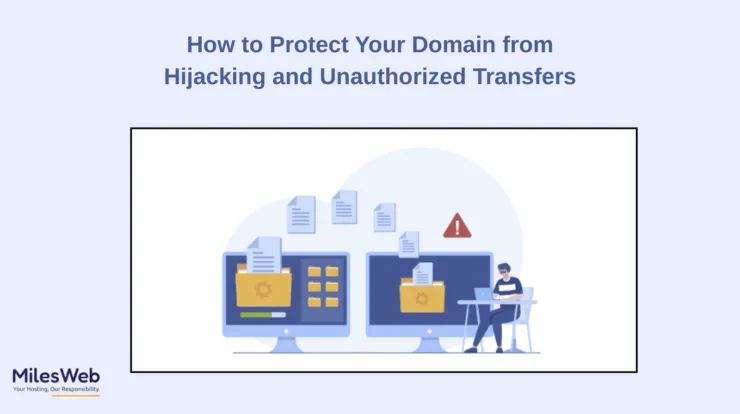
Think of domain hijacking as a digital title theft. It isn’t just someone hacking your WordPress website to change a few images; it is a total change of ownership at the registry level. An attacker rewrites the official title to your URL, taking it out of your account and moving it to theirs. Acquiring the domain allows an unauthorized party to monitor your corporate communications, redirect your visitors, and demand payment for the return of your online identity.
How Does Domain Hijacking Work?
Most hijackers don’t sit in a dark room “hacking” your website—they just exploit your administrative strategies. They usually start by phishing the email account linked to your registrar. Once they’re in your inbox, they reset your login, disable the transfer locks, and email themselves the EPP authorization code. Some individuals use “homograph” tactics, registering a domain that appears identical to yours by using visually similar characters from different alphabets. This technique aims to misguide support personnel into granting unauthorized access by replicating your authentic identity. Displaying your contact information publicly without secondary protection creates a preventable risk for your online property.
Types of Domain Hijacking Attacks
- Phishing: Scammers email you fake “billing failed” notices to gain your password on a fake login page.
- Social Engineering: Calling your registrar, posing as a “locked-out owner,” and using public data to “prove” they are the boss.
- Domain Shadowing: Instead of stealing the whole website, they quietly add subdomains to your URL to host malware without you noticing.
- Redemption Sniping: Bots that track your expiration date and buy your domain the millisecond it reaches the open market if you miss a payment.
6 Steps to Prevent Domain Hijacking
Avoid the Password-Only Login
Credentials are vulnerable to theft. Implementing a physical security key or an authenticator app for your registrar account provides a necessary layer of protection. Hardware authentication stops attackers where passwords fail. An intruder stays locked out unless they possess your physical token.
Demand a Registry-Level Lock
A standard “Registrar Lock” is easy to bypass if an unauthorized entity gains entry to your account. Registry lock provides a rigorous security layer by requiring manual, offline verification between the registrar and the central registry before any significant changes occur.
Hide Your Personal Contact Info
WHOIS records act as a roadmap for intruders. Masking your contact details with proxy data reduces your digital footprint and shields you from those searching for your personal information. This prevents social engineers from getting the details they need to impersonate you during a support call.
Isolate Your Admin Email
The email address tied to your account serves as your registrar’s master key. Never use a free, generic inbox for this. Send your admin alerts to a private, secure server instead of your main inbox, where phishing is common.
Audit Your User Permissions
Review who has access to your domain settings every few months. If an old employee or an outside contractor still has a login, you have a security hole. Revoke access as soon as a person no longer needs it.
Pre-Pay and Auto-Renew
Renewing early protects your asset from the hazards of a last-minute oversight. Establishing a buffer period prevents unexpected banking glitches from leading to a lost registration. Prepaying for five or ten years ensures a simple credit card error doesn’t accidentally drop your domain onto the open market for hijackers to acquire.
Securing the Infrastructure with MilesWeb
Maintaining these defenses is much easier when your tools are built into your hosting. MilesWeb integrates domain management with proactive protection by including professional email accounts and daily backups within its service packages. Having these backups ready allows you to regain control and resume your operations without losing years of work. By keeping your email and domain under a provider that enforces strict logging and security protocols, you eliminate the common gaps that deceptive actors exploit.
Concluding Insights
Maintaining control over your URL requires building a defensive strategy that is more resilient than the targets surrounding you. When you layer on registry locks and hardware keys, most hijackers will just move on to an easier target.
MilesWeb strengthens your defensive layer by providing the encrypted SSL certificate and redundant backups needed to keep your communications private and your data safe. Staying proactive with these audits ensures that your digital home stays exactly where it belongs—firmly in your hands.