Let me ask you something honest.
How much of your SEO effort went into ranking on Google last year? And how much of it went toward making sure ChatGPT recommends your business when someone asks it a question in your niche?
If the answer to the second question is “none” or “not much” – you are not alone. But you are losing ground fast.
Search has changed more in the last 18 months than it did in the previous decade. People are no longer just typing short keywords into Google. They are asking full questions to AI tools like ChatGPT, Perplexity, and Gemini – and those tools are picking their sources carefully. If your brand is not on that shortlist, you simply do not exist in that conversation.
That is exactly why Hybrid Engine Optimization (HEO) has become the most talked-about framework in digital marketing in 2026. This guide breaks down exactly what it is, where it came from, and how you can use it to grow your visibility across every search surface that matters today.
What is Hybrid Engine Optimization (HEO)?
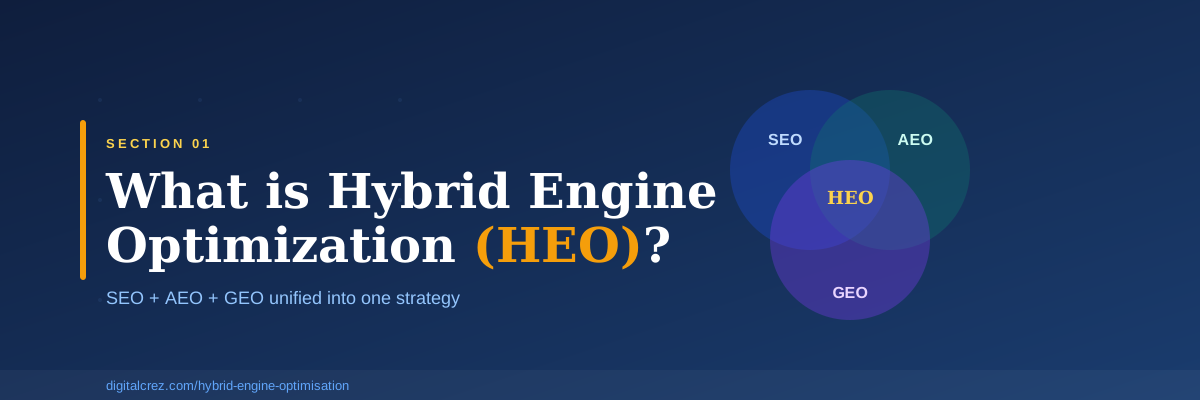
Hybrid Engine Optimization is a unified digital marketing strategy that combines three existing approaches – SEO, AEO (Answer Engine Optimization), and GEO (Generative Engine Optimization) – into a single, coordinated playbook.
In plain terms: HEO is the practice of making your website visible everywhere people search in 2026, whether that is on Google, Bing, ChatGPT, Perplexity, Gemini, or Google’s own AI Overview.
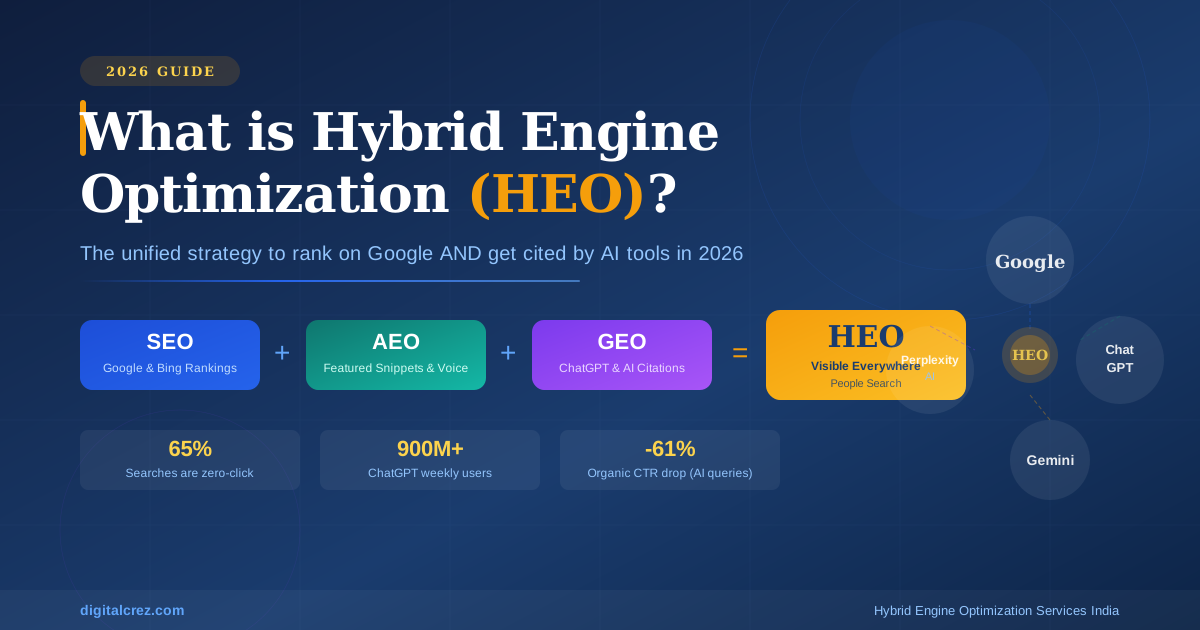
HEO = SEO + AEO + GEO – One unified strategy. Every search surface. No gaps.
- SEO – Ranking on Google and Bing through technical, on-page, and off-page optimization
- AEO – Becoming the direct answer in featured snippets, People Also Ask, and voice search
- GEO – Being cited and recommended inside ChatGPT, Perplexity, Gemini, and Google AI Overviews
If you want to see what a full-service HEO strategy looks like in practice, the team at Digital Crez offers dedicated HEO services in India – combining all three disciplines under one roof.
Where Did the Term HEO Come From?
The term “Hybrid Engine Optimization” was coined by Jori Ford, Chief Marketing and Product Officer at FoodBoss, during her talk at SEO Week 2025 in New York City – hosted by iPullRank from April 28 to May 1, 2025.
Her session was titled “Hybrid Engine Optimization: A Crawler Driven Approach to Maximizing Search & AI Visibility.”
Ford chose the word “hybrid” deliberately. By 2025, the SEO industry had become flooded with new acronyms – AEO, GEO, LLMO, AIO, SGE – and she felt professionals were getting overwhelmed trying to manage each as a separate discipline. Her point was simple: you do not need five strategies. You need one strategy that covers everything.
“Hybrid just means it doesn’t have to be that hard. We can figure out how to create balance.” – Jori Ford, SEO Week 2025
Within months, HEO had spread across agency blogs, podcast discussions, and marketing conferences worldwide. By early 2026, it had become the working framework for modern search marketing – including in India, where AI search adoption has accelerated faster than most expected.
Why Has SEO Changed So Dramatically?
1. Organic Click-Through Rates Are Collapsing
When Google places an AI-generated answer at the top of search results, most users read it and leave – they do not scroll down to click your link.
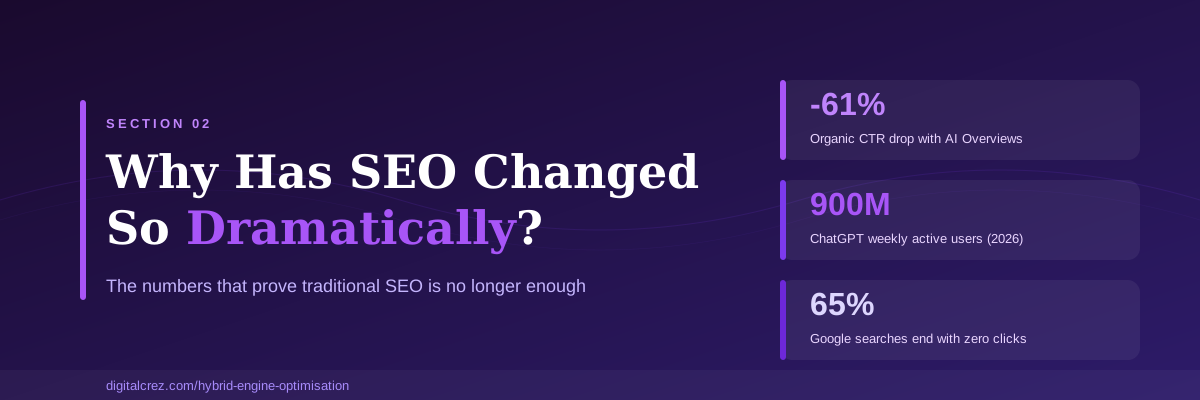
A Seer Interactive study found that organic CTR for queries with AI Overviews dropped 61%, falling from 1.76% to just 0.61% between June 2024 and September 2025. Even queries without AI Overviews saw a 41% CTR decline in the same window.
Ranking #1 simply does not deliver the same traffic it used to.
2. AI Tools Have Become Mainstream Search Destinations
ChatGPT now has over 900 million weekly active users as of early 2026 – more than double the 400 million it had in February 2025. Perplexity processes around 780 million queries per month and reached a $20 billion valuation in 2025.
These are not niche tools for tech enthusiasts. They are where millions of your potential customers go to find answers, make decisions, and discover brands like yours.
3. Zero-Click Searches Have Hit Record Levels
According to SparkToro’s zero-click study, for every 1,000 Google searches in the US, only 360 clicks go to the open web. By mid-2025, zero-click searches had reached around 65% globally – with mobile users 66% more likely to leave without clicking than desktop users.
4. Google AI Overview Is Everywhere Now
The share of Google queries triggering AI Overviews jumped from 6.49% in January 2025 to 13.14% in March 2025 – a 102% increase in just two months. Even if you rank #1, your link sits below an AI-generated answer that already gave the user what they wanted.
5. Trust Signals Have Been Redefined
Traditional SEO measured trust through domain authority and backlinks. AI engines weigh something broader – brand mentions, expert authorship, original research, E-E-A-T signals, and consistency of information across the web.
This is precisely why a comprehensive HEO strategy addresses all these dimensions simultaneously, rather than focusing on just one.
SEO vs AEO vs GEO vs HEO: What Is the Actual Difference?
Let us clear up the confusion once and for all.
| Approach | Emerged | Optimises For | Goal |
| SEO | Mid-1990s | Google/Bing rankings | Traffic through organic links |
| AEO | ~2017 | Featured snippets, voice search | Become the direct answer |
| GEO | 2023 | ChatGPT, Perplexity, Gemini citations | Get recommended by AI tools |
| HEO | 2025 | All of the above, unified | Be visible everywhere people search |
The important nuance: HEO is not a replacement for SEO. It is SEO that has grown up to match how people actually search in 2026. Your technical SEO health, backlinks, and on-page optimization still matter – because AI engines trust sites that Google trusts. HEO simply adds the AI-specific layers on top.
The 7 Pillars of a Winning HEO Strategy

Think of these seven pillars as the complete HEO checklist. Every important page on your website should pass all seven to compete effectively in 2026 search.
Pillar 1: Technical Health & Crawlability
Nothing else works if the basics are broken. Both Google’s crawlers and AI bots – GPTBot (ChatGPT), ClaudeBot (Anthropic), PerplexityBot – need to access and read your site without friction. Fast load times, clean architecture, correct indexing directives, no broken paths. A useful exercise: check your server logs to see which AI bots are visiting your site and how often. Most website owners are completely unaware.
Pillar 2: E-E-A-T – Experience, Expertise, Authoritativeness, Trust
AI engines do not cite random content – they cite sources they deem credible. Author profiles with verifiable credentials, expert-written content, external citations, and consistent factual accuracy all feed into whether an AI tool will recommend your brand. This is one of the most underinvested areas for most Indian businesses – and one of the biggest opportunities.
Pillar 3: Topical Authority (Not Just Keywords)
A site with three shallow blog posts will not be cited by AI engines. The strategy is to build content clusters – a pillar page covering a broad topic, supported by in-depth articles on every related sub-topic, question, and nuance in your niche. This blog post is itself designed to support the core pillar page on HEO services at Digital Crez – reinforcing topical authority across every relevant sub-topic.
Pillar 4: Structured Data & Schema Markup
Schema markup is the language AI systems read to understand what your content is about. When you add FAQ schema, HowTo schema, Article schema, or Product schema to your pages, you are giving AI engines a clean, structured feed of your content they can extract and use confidently. Without schema, AI tools have to guess. With schema, you are telling them directly.
Pillar 5: Conversational & Intent-First Content
Traditional SEO content was built around keywords. HEO content is built around questions. People do not ask ChatGPT “best HEO agency India.” They ask “which digital marketing agency in India also optimizes for ChatGPT and Perplexity?” – longer, more natural, more specific. Rewriting content to match these conversational query patterns is a core HEO execution task.
Pillar 6: Brand Entity & Knowledge Graph Presence
AI engines understand the world through entities – clearly defined real-world things with clear relationships between them. If your brand is not a recognised entity in Google’s Knowledge Graph, you are essentially invisible to how AI systems categorise and recommend businesses. Building your entity means a consistent, structured presence across your website, authoritative directories, and third-party media mentions.
Pillar 7: Multi-Surface Visibility Monitoring
Traditional SEO tracks Google rankings. HEO tracks rankings plus AI Overview appearances, ChatGPT mentions, Perplexity citations, and voice search results. If you are only looking at Google Search Console, you are seeing at best half the picture. This is where the monthly HEO reporting from Digital Crez adds real value – covering every surface in plain English, every month.
The GEO Research That Changed Everything
In November 2023, researchers from Princeton University, Georgia Tech, The Allen Institute for AI, and IIT Delhi published a paper titled “GEO: Generative Engine Optimization” on arXiv. They built a benchmark called GEO-bench using 10,000 diverse queries and tested nine different optimization strategies.
Their findings were striking: properly optimised content saw visibility improvements of up to 40% in AI-generated responses. A page sitting at position 5 in Google saw a 115% visibility jump in AI answers when proper citations were added.
The single biggest factor? Original statistics and data – providing verifiable numbers with named sources gave a 33.9% visibility boost. AI engines cannot generate original data, so they gravitate toward sources that provide it. This research gave the SEO industry its first academic foundation for optimising content specifically for AI search.
How HEO Works in Practice: A Step-by-Step Process
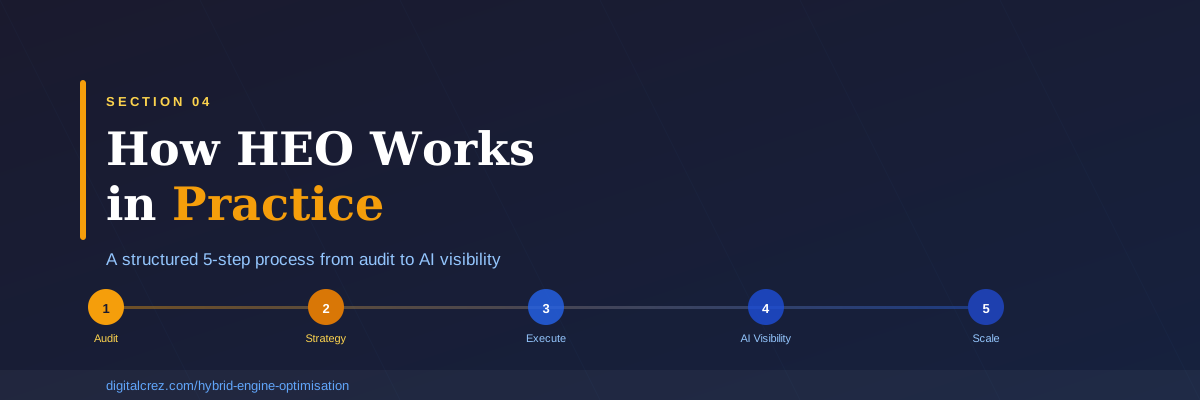
- HEO Discovery Audit – Full analysis of your Google rankings, AI Overview appearances, competitor visibility, technical health, content gaps, and entity presence.
- HEO Strategy & Roadmap – A custom 90-day roadmap: which pages to optimise, which schema to add, which content clusters to build, which AI citation opportunities to target first.
- Content & Technical Execution – On-page optimisation, schema implementation, content rewriting, new content creation, entity-building, and E-E-A-T signal development.
- AI Visibility Building – Targeted outreach, digital PR, authoritative citation building, and structured data layering designed to earn mentions in AI-generated answers.
- Report, Optimise & Scale – Monthly reports covering rankings, AI citations, leads, and traffic. Continuous iteration and scaling of what is working across both traditional and AI platforms.
Digital Crez offers this as a fully managed HEO service in India – all five steps, one team, transparent monthly reporting.
HEO vs Traditional SEO: Why You Cannot Rely on One Alone
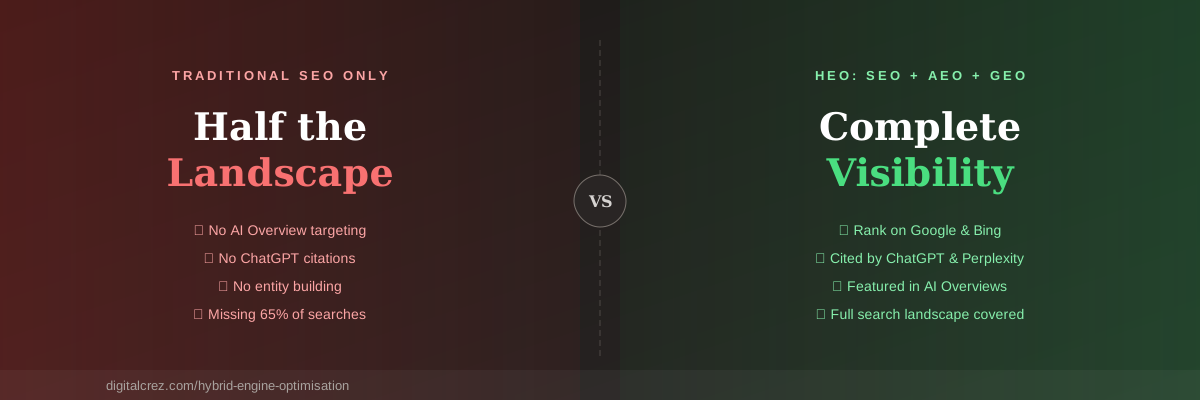
If you are only doing traditional SEO in 2026, you are optimising for roughly half of the search landscape at best.
| Visibility Signal | Traditional SEO Only | HEO (SEO + AEO + GEO) |
| Google organic rankings | ✔ Yes | ✔ Yes (stronger) |
| Google AI Overview citations | ✖ Not targeted | ✔ Core objective |
| ChatGPT / Perplexity mentions | ✖ Not targeted | ✔ Monitored & optimised |
| Featured snippets & People Also Ask | Partial | ✔ Systematically targeted |
| Voice search answers | ✖ Rarely optimised | ✔ Built into content strategy |
| Schema & structured data | Basic | ✔ Full implementation |
| Brand entity in knowledge graph | ✖ Not addressed | ✔ Actively built |
| E-E-A-T credibility signals | Partial | ✔ Core of content strategy |
| Zero-click search visibility | ✖ Not protected | ✔ Turned into brand exposure |
| AI citation reporting | ✖ No | ✔ Every month |
Is HEO Relevant for Indian Businesses?
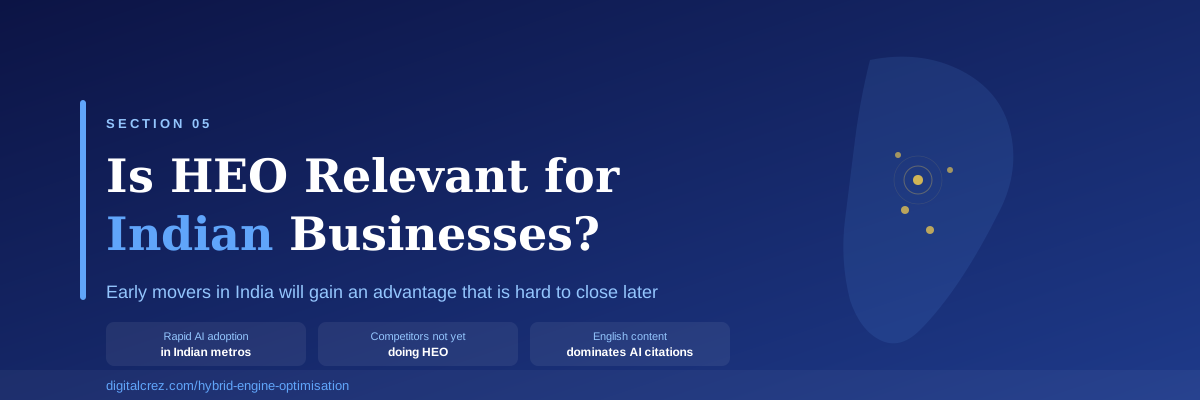
Absolutely – and arguably more so than for many Western markets, for a few key reasons.
- AI adoption is accelerating fast. Indian users in metros and Tier 1 cities are rapidly adopting ChatGPT, Perplexity, and Google’s AI tools. When a business owner in Mumbai asks ChatGPT “which digital marketing agency should I use for SEO in India” – the brands that appear in those AI answers gain enormous trust advantages.
- English-language content dominates AI citations. Since most AI tools currently prioritise English-language content, Indian businesses with high-quality English content, proper schema, E-E-A-T signals, and topical authority are well-positioned to compete.
- Most Indian competitors are not doing this yet. The vast majority of Indian businesses are still running traditional SEO playbooks. The HEO opportunity right now is significant – early movers will build an advantage that is very difficult to close later.
The Digital Crez team built their HEO service offering specifically around the Indian market – including understanding how Indian audiences search across AI tools and what local E-E-A-T signals matter most by industry.
How Long Does HEO Take to Work?
- Technical improvements – results visible within a few weeks
- On-page and content optimisations – typically influence Google rankings within 2–3 months
- AI visibility (ChatGPT, Perplexity, Google AI Overview) – typically begins within 60–90 days
- Topical authority and entity-building – results compound over 6–12 months
HEO is not a shortcut. It is a more complete and durable approach to search visibility. The brands that start building it now will have a structural advantage in 12 months that will be very difficult for late movers to replicate quickly.
Common Questions About HEO
Does HEO replace traditional SEO?
No. Traditional SEO remains the foundation. AI engines trust sites that Google trusts – so technical health, backlinks, and on-page optimisation still matter. HEO adds the AI-specific layers on top, it does not remove the existing ones.
What is the difference between HEO, GEO, AEO, and LLM SEO?
GEO focuses specifically on AI-generated content citations. AEO focuses on featured snippets and direct answers. LLM SEO focuses on large language model visibility specifically. HEO is the umbrella framework that brings all of them together alongside traditional SEO – so you do not need five separate strategies. You need one.
Can a small business in India afford HEO?
Yes. HEO does not require an enterprise budget. What it requires is clear, well-structured content, good technical foundations, and consistent off-site presence in your topic area. Entry-level HEO packages from Digital Crez start at ₹12,000/month – covering the core elements needed to start building AI visibility.
How do I know if my site is being cited by AI tools?
Most standard analytics tools do not track this yet. A proper HEO setup includes dedicated AI citation monitoring – checking whether your brand appears in responses across ChatGPT, Perplexity, Google AI Overview, and Gemini for your target queries.
The Bottom Line
Here is where we are in 2026: search has split into two parallel universes. There is traditional search – Google rankings, clicks, organic traffic. And there is AI-powered search – ChatGPT answers, Perplexity citations, Google AI Overviews. Most SEO strategies are still living entirely in the first universe. HEO is the framework that lets you compete in both.
The brands that get cited by AI tools are building a form of credibility and visibility that goes far beyond a Google ranking. When ChatGPT recommends your business, it is not just a traffic source – it is a trust signal that converts at a completely different level.
| Ready to Rank on Google and Get Cited by AI?
Get a free HEO audit from Digital Crez. We will show you exactly where your brand is visible, where it is missing, and what it will take to dominate both traditional and AI search in your industry. → Get Your Free HEO Audit at digitalcrez.com/hybrid-engine-optimisation |
Related Reading from Digital Crez
→ Our complete HEO services and packages
→ SEO Services India
→ Digital Marketing Services